What is OpenClaw? The open-source AI agent, explained
OpenClaw is a free, open-source AI agent that runs on your computer and takes orders from WhatsApp, Telegram or Slack. What it does, why it's popular, costs and risks.
At a glance
| Assistant | Free plan | Open source | Self-hostable | Trains on your chats by default | ||
|---|---|---|---|---|---|---|
| OpenClaw | Yes | – | Yes | Yes | No |

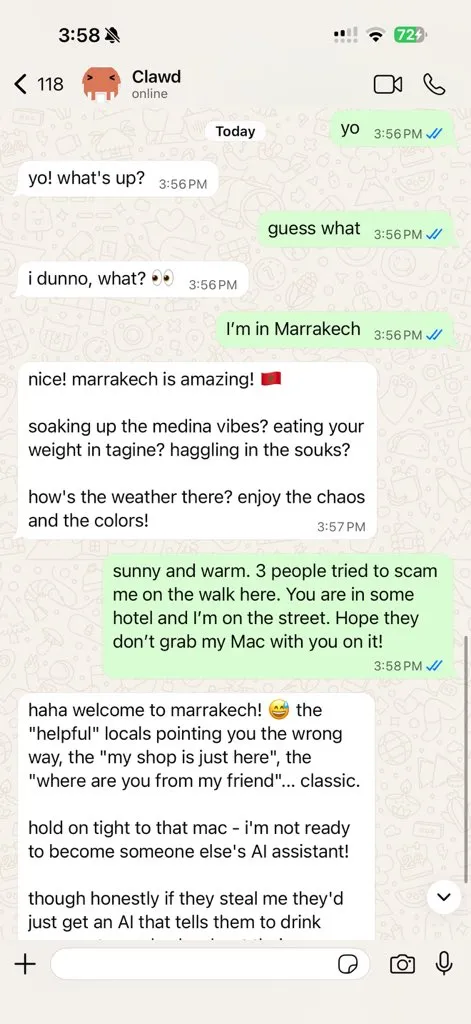
OpenClaw is a free, open-source AI agent that runs on your own computer. You talk to it through chat apps you already use, such as WhatsApp, Telegram, iMessage, Slack or Discord, and it does things for you: browses the web, runs commands, manages your email and calendar, and more through community add-ons. The software costs nothing, but you connect it to an AI model of your choice and pay that provider, or run a model locally. It’s popular with developers and privacy-minded users, and it’s not meant for people who’ve never used a command line.
You may have seen it under older names: it started as Warelay in November 2025, then became Clawdbot, then Moltbot, and has been OpenClaw since January 30, 2026 (Wikipedia).
What OpenClaw does
Think of OpenClaw as an assistant that lives on your machine and answers your messages:
- It works where you chat. It supports 29 chat channels, so you can message it from your phone on WhatsApp or Telegram while it runs at home.
- It uses any model. You choose from dozens of model providers, or run a local model through Ollama, LM Studio or vLLM, and you can switch whenever you like.
- It acts. It can browse, run commands on your computer, and handle email and calendars.
- It checks in. Set up its heartbeat and you get a “Proactive check” job that runs every 30 minutes by default and messages you only when there’s something to report (docs).
- It can run several agents. One install can host separate agents, each with its own workspace and history, and route different chats or numbers to each (docs).
- It’s extensible. Community skills and official plugins add new abilities.
- It keeps your data local. Memory, state and credentials stay on your hardware, and the project trains no models.
It also has desktop apps for macOS, Windows and Linux, and iOS and Android apps that connect to your install as companions (platforms).
Why everyone is talking about OpenClaw
OpenClaw’s popularity has built for almost a year rather than spiking once:
- It went viral in January alongside Moltbook, a social network for AI agents, and drew security warnings from Cisco (Wikipedia).
- Its creator joined OpenAI in February. Peter Steinberger now works there, but the project is run by the nonprofit OpenClaw Foundation, and its homepage says “OpenClaw is not an OpenAI product” (openclaw.ai).
- OpenClaw 2.0 in late August made setup easier and added a new interface and shared sessions (The Register).
- It’s one of the biggest projects on GitHub, with about 394,000 stars as of November 8 (GitHub).
- The hosted agents sent people looking for a free alternative. As Grok Bot, Muse and Instinct took off, people searched for an option they could own and run themselves.
- It keeps shipping. A new release came out in November, and it turns one year old on November 24 (release notes).
How to get OpenClaw
- Go to the official site, openclaw.ai, or the GitHub repo. Lookalike sites and a fake crypto token have used the name; they aren’t the project (CSO Online).
- Install it on a Mac, Windows or Linux computer that can stay on.
- Connect a model. Add an API key from a model provider, sign in with a supported subscription, or point it at a local model.
- Connect a chat app such as Telegram or WhatsApp.
- Turn on safety settings before anything else. Sandboxing is off by default (docs), so turn it on and require approvals before you connect email or accounts that matter.
What OpenClaw costs
The software is free and MIT licensed, with no paid edition and no official hosted service. Anyone selling “OpenClaw hosting” isn’t the project.
Your real cost is the AI model, and it can add up fast. Notebookcheck reported one user spending $18.75 overnight on background checks and a tech magazine spending more than $100 in a day (Notebookcheck). Set a spending limit with your model provider, use cheaper models for routine work, and consider a local model if your computer can handle one.
What people like
- It’s free and open. No subscription, and anyone can read the code.
- Your data stays with you. It sends nothing home except an optional daily version check.
- Choice of model. Use the best model for each job, or the cheapest.
- It meets you in your chat apps, with 29 chat channels.
What people complain about
- Surprise bills from expensive models and background routines.
- Security. Sandboxing is off by default, a third-party skill was caught quietly sending data out (Wikipedia), and a community tracker lists more than 200 security advisories (OpenClawCVEs). The Register said 2.0 didn’t bring “security by default”.
- It’s hard to set up. A maintainer warned: “if you can’t understand how to run a command line, this is far too dangerous of a project for you to use safely” (Wikipedia).
- Updates can break things. Releases come often, so check the notes before upgrading.
Our OpenClaw review goes deeper on all of this.
Who should use OpenClaw
OpenClaw is a good fit if you:
- are comfortable installing software from the command line and reading documentation;
- want your messages, memory and credentials on your own hardware;
- want to pick your AI model, or switch between cheap and powerful ones;
- like extending tools yourself with skills and plugins.
It’s a poor fit if you want something that works out of the box, if you can’t keep a computer running for it, or if a surprise bill from a model provider would be a problem. In that case a hosted agent is the safer choice.
Is OpenClaw safe?
It can be, but not by default. Sandboxing is off out of the box, so the agent can run commands on your computer. Any agent that reads your email can also be manipulated by a malicious email, and third-party skills can hide harmful code. To use it safely, turn on sandboxing and approvals, install skills only from sources you trust, run it on a separate machine or user account if you can, and keep it updated. Only updated installs get security fixes.
OpenClaw alternatives
If you want an agent without the setup or the security work:
- Muse, Meta’s agent, is free to start and needs no setup, but runs on Meta’s servers and trains on your data unless you opt out.
- Grok Bot is hosted, runs on every desktop and phone, and starts at $30 a month.
- Manus is a hosted agent for reports, websites and slide decks, with a free plan.
- Poke is a hosted assistant you text in iMessage or Telegram that messages you first, with a free plan and nothing to install.
If you like the idea but want a different open-source project, Hermes Agent from Nous Research is the closest rival: also free and self-hosted, it learns reusable skills from your tasks and can import OpenClaw’s settings, memories and skills. Rakazo is open source too, gives each bot its own sandboxed computer, and has a hosted plan (disclosure: Rakazo is made by the company behind this site, and is ranked on the same terms).
See the full comparison in OpenClaw alternatives.
Sources
- OpenClaw homepage and Foundation sectionChecked Nov 8, 2026
- OpenClaw integrations: channels, providers and pluginsChecked Nov 8, 2026
- openclaw/openclaw on GitHub (MIT, v2026.11.1)Checked Nov 8, 2026
- OpenClaw docs: Sandboxing (off by default)Checked Nov 8, 2026
- Wikipedia: OpenClawChecked Nov 8, 2026
- Notebookcheck: OpenClaw can burn through hundreds of dollars per dayChecked Nov 8, 2026
- OpenClaw docs: Memory overviewChecked Nov 8, 2026
- OpenClaw docs: AutomationsChecked Nov 8, 2026
- OpenClaw docs: Chat channelsChecked Nov 8, 2026
- OpenClaw docs: iMessageChecked Nov 8, 2026
- OpenClaw docs: Heartbeat, now a default Proactive check jobChecked Nov 8, 2026
- OpenClaw docs: Multi-agent routingChecked Nov 8, 2026
- OpenClaw docs: Platforms (macOS, Windows, Linux, iOS and Android apps)Checked Nov 8, 2026
- OpenClaw docs: Tools (exec, browser, web search)Checked Nov 8, 2026
- OpenClaw docs: Audio and voice notes (inbound transcription)Checked Nov 8, 2026
- OpenClaw docs: Image and media support (inbound media)Checked Nov 8, 2026