
Poke review: the AI assistant you text, and what its free plan leaves out
Poke is an AI assistant you text in iMessage or Telegram that reads your email and calendar and messages you first. Who it suits, its limits and privacy trade-offs.
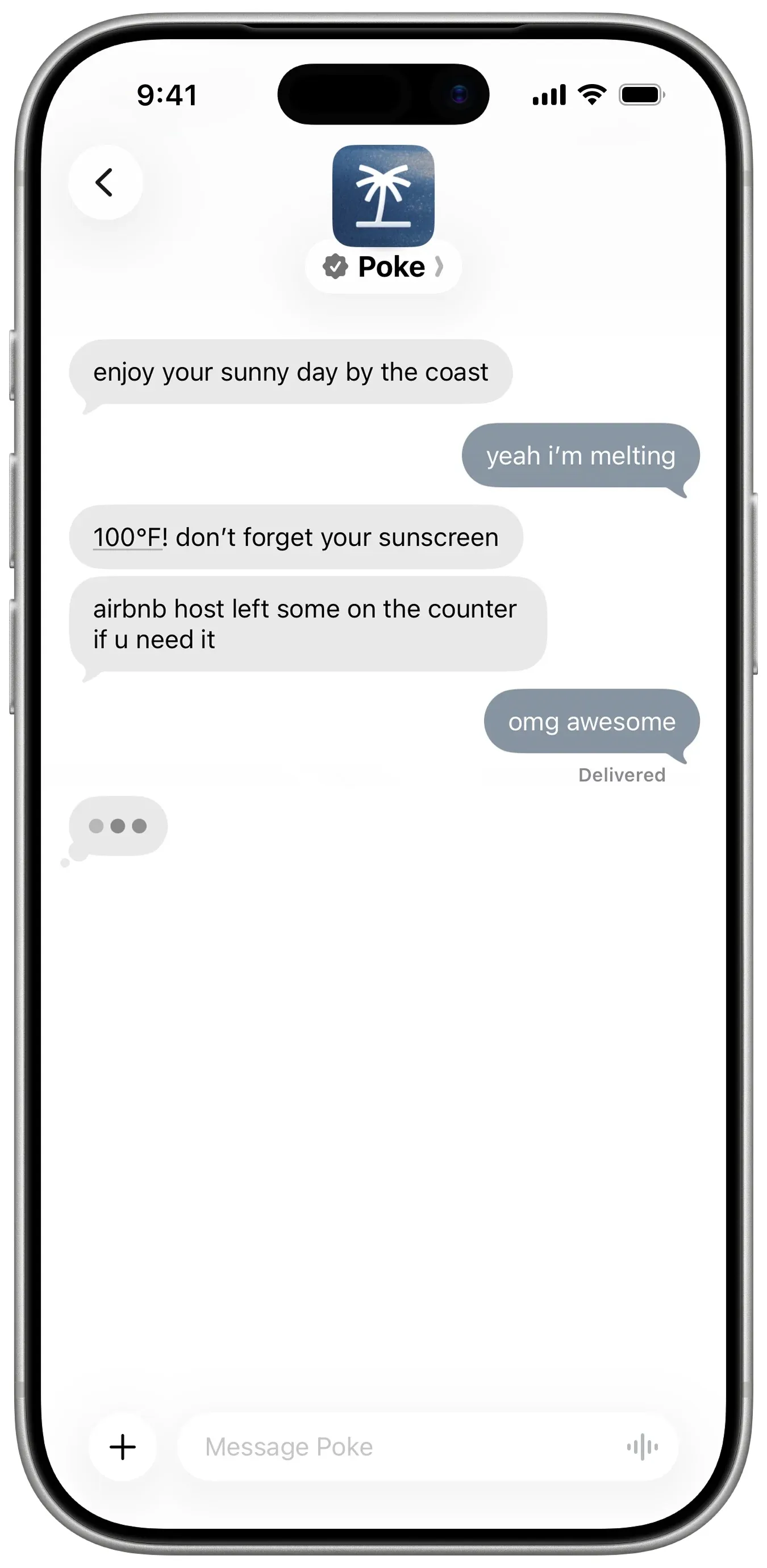
Visit PokePoke is an AI assistant that lives in your text messages. You sign up at poke.com with your phone number, connect your email and calendar, and from then on you text it like a contact in iMessage, SMS or Telegram. It reads what you’ve connected, runs small automations, and texts you first when something needs your attention. There is no app to install and no setup beyond connecting accounts, which makes it the easiest assistant on this list to start using.
The trade-offs are privacy and transparency. Poke may use your data to train its models unless you switch on Maximum Privacy, it doesn’t say which models it uses, and since July 2026 it belongs to Cognition, so its direction may change.
Who Poke is for
Poke is for people who want help with their personal life without learning a new tool. TechCrunch described it as a simpler, less technical take on what OpenClaw does (TechCrunch), and that’s the right way to think about it: you get an agent in your chat app without running a server.
It fits best if you:
- use Gmail or Outlook, which Poke fully supports for email, calendar and contacts (iCloud and Yahoo mail aren’t planned for now, per the FAQ);
- live in iMessage and want reminders, briefings and quick errands in the same thread as your friends;
- are a developer who wants to wire your own services into a texting assistant through MCP.
It fits poorly if you need an assistant for a team, want to choose the model, or don’t want your conversations used for training by default.
What it does for you day to day
The uses TechCrunch reported from Poke’s users are small and frequent: calendar management and daily planning, email alerts, umbrella and medication reminders, health and fitness tracking, smart-home control, photo editing, and sports or news digests (TechCrunch). That’s the sweet spot. Poke isn’t trying to build you a slide deck; it’s trying to be the contact who tells you a flight changed before you notice.
Three things set it apart:
- It texts first. Poke uses your connected accounts and its memory to reach out on its own, rather than waiting to be asked. This is the feature Cognition’s CEO singled out when buying the company: Poke is how working with an always-on agent “should feel” (Cognition).
- Recipes. Automations are packaged as one-click recipes you can share. They connect to services from Gmail and Notion to Strava, Oura, Philips Hue and Sonos, plus developer tools such as GitHub, Vercel and Sentry. People who publish recipes earn $0.10 to $1 for each user who signs up through them (TechCrunch).
- Small extras. Claim a handle and Poke will publish a personal website at yourname.poke.site and update it when you ask (FAQ).
It’s popular. Cognition said people exchanged more than 100 million messages with Poke in the three months before the July 2026 deal (Cognition).
Setup effort
Close to none. Enter your phone number, connect Gmail or Outlook and your calendar, and start texting. You pick which messaging channel Poke uses in its settings, and it may text you from different numbers depending on the channel (FAQ).
In June 2026 Apple approved Poke as the first AI agent on Apple Messages for Business, so it can appear in Messages as a verified business rather than an ordinary number. Existing users were invited to switch, but switching is optional (TechCrunch).
Limits to know
- The free plan doesn’t include background automations. Real-time automations that run in the background are listed as a Pro feature ($19 a month) on the pricing page. Poke’s co-founder told TechCrunch that tasks which don’t need real-time data may stay free, while things like per-email automations or flight check-ins are what drive cost. If what you want is “watch my inbox and text me”, budget for Pro.
- No published credit amounts. The pricing page doesn’t say how many credits each plan includes, and Ultra mentions pay-as-you-go usage beyond them. You can’t work out in advance how far a plan stretches.
- WhatsApp is restricted. Meta’s limits on general-purpose chatbots mean WhatsApp works only in some markets; Poke’s co-founder called Meta’s fees “malicious compliance” (TechCrunch).
- One phone number per account. Changing it means emailing support (FAQ).
- Unknown models. Poke routes each task to the model it thinks suits it, from big labs or open source (TechCrunch), but doesn’t tell you which.
- New owner. Cognition says Poke users “can continue using the product just as before” and that its models and infrastructure will soon make Poke faster (Cognition). Cognition also says it wants Devin, its coding agent, to work the way Poke does, so expect changes.
Ultra ($199 a month) adds Poke Human: people who handle real-world tasks like reservations and phone calls, with costs charged at cost from your credit balance (FAQ). That’s an unusual feature, but at that price it’s for a small group.
Privacy
Poke’s privacy notice lists training its AI models among the uses of personal data, and says data from users who select Maximum Privacy will not be used for training (privacy notice). So training is on unless you opt out. Turn on Maximum Privacy when you sign up if that matters to you.
On the positive side, Poke says it doesn’t sell Google user data or pass it to advertising platforms, and humans don’t read it without your agreement (privacy notice). It told TechCrunch that its team can’t see message contents by default and that it runs regular penetration tests, though TechCrunch noted it hadn’t audited those claims itself. Poke Human operators see only the details needed for a task, not your chat history, memories or integrations. Deleting your account takes up to 24 hours, and backups may take longer (FAQ).
Compared with the rest of this list, that puts Poke in the middle: like Muse, it trains by default with an opt-out; Lindy says it never trains on your data; and self-hosted agents keep your data on your own machine. See private AI assistants if this is your deciding factor.
How Poke compares
vs Instinct. The closest concept: an assistant you text. Instinct can also take calls and leans toward errands like travel and groceries, but it’s invite-only. Poke is open to anyone today and has a free plan.
vs Lindy. Lindy also works over iMessage and texts you briefings, but it’s built for work: inbox triage in your voice, meeting notes, a shared teammate in Slack. It costs $49.99 per user a month after a 7-day free trial. Poke is the personal, cheaper option.
vs Muse. Both are free to start and need no setup. Muse runs on its own cloud computer and can book travel and shop, while Poke is lighter: texts, reminders and recipes. Muse also trains on your interactions unless you opt out.
vs OpenClaw and Hermes Agent. These are the open-source agents you run yourself. They reach you on WhatsApp, Telegram, iMessage and more, let you choose the model, and keep your data on your machine, but you handle setup, security and the model bill. Poke gives you the “agent in your messages” experience without any of that.
vs Rakazo. Rakazo runs several bots, each with its own job, computer and routines, on the model you choose, and is open source. It’s built for recurring jobs you set up once, not for casual texting, and its Telegram, WhatsApp and iMessage channels need self-hosting. (Disclosure: Rakazo is made by the company behind this site, and is ranked on the same terms.)
vs Grok Bot, dots and Claude Duet. These big-lab agents have their own cloud computers and can do heavier work, but they start at $20 to $100 a month and live in their own apps or Slack rather than your texts. Poke is cheaper to start and lives where you already text.
On our checklist, Poke acts in your accounts, works while you’re away, messages you first and lives in iMessage and Telegram. We don’t have a source on whether it can run several separate assistants. For other options, see Poke alternatives or the full AI assistant ranking.
Verdict
Poke is the best assistant here for someone who just wants to text a helpful contact: no app, no server, a free plan, and a habit of telling you things before you ask. For reminders, email alerts and a daily plan, it’s hard to beat on effort.
Go in knowing three things. Background automations need Pro, so “free” covers less than it seems. Your data trains Poke’s models unless you pick Maximum Privacy. And the company now belongs to Cognition, which has promised continuity but clearly has its own plans. If those are fine, start on the free plan and upgrade only when you want it watching your inbox for you.
Pricing
Free
Free
- No credit card required
- Connect your apps, email and calendar
Pro
$19/mo
- Frontier models for complex tasks
- Real-time automations running in the background
- Higher rate limits and priority support
Ultra
$199/mo
- Frontier models powering every action
- Highest rate limits and highest-priority support
- Pay-as-you-go usage beyond included credits
- Poke Human for real-world tasks, with expenses charged at cost
Features
| Web search | Yes |
|---|---|
| Image generation | Unknown |
| Voice mode | Yes |
| File uploads | Yes |
| Memory | Yes |
| Takes actions for you | Yes |
| App integrations | Yes |
| Works on its own | Yes |
| Messages you first | Yes |
| Runs several bots | Unknown |
Strengths
- Nothing to install: you sign up with a phone number and text it like a contact
- Messages you first, using your connected services and memory
- Free plan with no credit card, and email and calendar included
- Connects to Gmail, Outlook, Google Calendar, Notion, GitHub, Linear and many more apps, plus custom integrations through MCP
- Shareable automation recipes, and developers can build their own
Weaknesses
- Uses your data to train its AI models unless you choose Maximum Privacy
- WhatsApp support is limited to some markets
- Only one phone number per account
- Does not say which AI models it uses, and does not publish how many credits each plan includes
- Now owned by Cognition, so the product's direction may change
Best for
- People who want an assistant inside the texting app they already use
- Busy people who want nudges and briefings without asking
- Developers who want to wire their own services into a texting assistant
Sources
- Poke homepageChecked Nov 8, 2026
- Poke pricingChecked Nov 8, 2026
- Poke FAQChecked Nov 8, 2026
- Poke privacy notice (last updated September 11, 2026)Checked Nov 8, 2026
- Cognition: welcoming The Interaction Company to Cognition (July 23, 2026)Checked Nov 8, 2026
- TechCrunch: Poke makes using AI agents as easy as sending a textChecked Nov 8, 2026
- TechCrunch: Apple approves Poke as the first AI agent on its Messages for Business platformChecked Nov 8, 2026
- Introducing Poke.com (launch announcement, September 8, 2025)Checked Nov 8, 2026
- Poke docs: Welcome (built-in web search)Checked Nov 8, 2026
- Poke release notes (web search, sharing images, attachments)Checked Nov 8, 2026